
Your Body Is Listening to How You Move
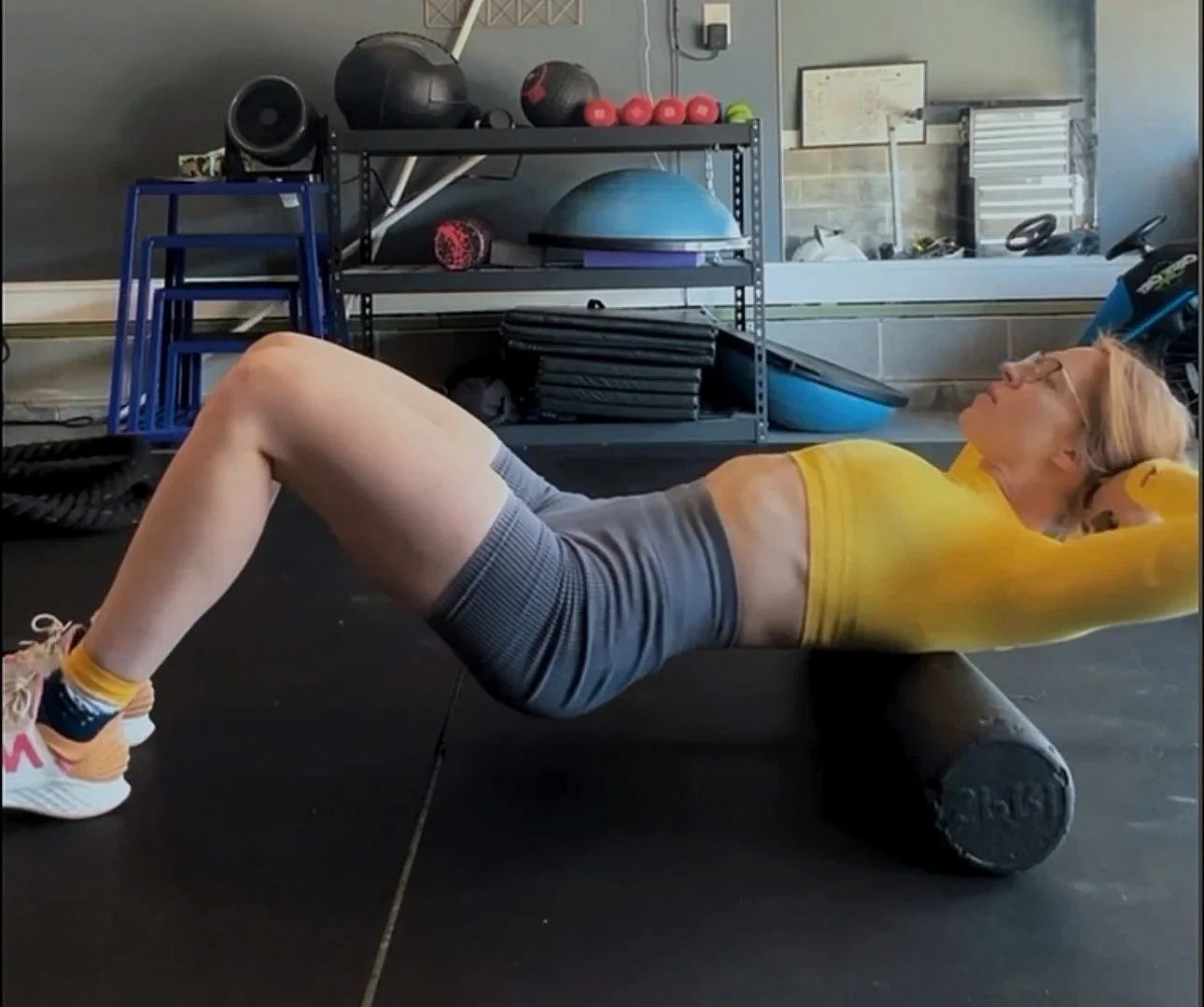
“Fascia is more about your body talking to your brain than about producing movement.”
Your body is constantly adapting.
Not just during workouts or when you're being intentional, but throughout your entire day. It's always taking in information and quietly reshaping how it feels, moves, and responds based on what you repeatedly give it.
A lot of that comes back to how you move.
This is the first piece in a series I've been wanting to write for a while now, called Your ___ Is Listening. It started as an observation more than a concept. The more I work with women, and the more I pay attention to my own body, the clearer it becomes that almost every part of us is listening to something. Our bodies are listening to how we move. Our nervous systems are listening to how we breathe. Our hormones are listening to how we eat, rest, and stress. Our minds are listening to the words we repeat to ourselves on loop.
We are not static. We are responsive. And once you start to see that, it changes how you approach almost everything.
So we're starting with the body. Specifically, how it listens to movement.
What I've Been Watching Happen
I've been seeing this firsthand as my pelvic floor and mobility classes have grown. That expansion has been one of the most rewarding parts of building Ascend, and honestly, it's been just as beneficial for me, especially through my own post-op healing.
There's something interesting about watching this in real time, both in my own body and in the women I'm working with. After surgery, I had to relearn what my body was capable of in a way I hadn't expected. I couldn't just push through the way I was used to. I had to slow down. Pay attention. Move in smaller, more deliberate ways. And what I noticed was that the slower I went, the more my body actually responded. Not in spite of the slower pace, but because of it.
When someone starts moving more consistently, and more intentionally, it doesn't take long before things begin to feel different.
Not drastically different. But noticeably.
I had a client come to me with chronic hip tightness she'd been carrying for years. She assumed she just needed to stretch more. We didn't actually add more stretching. We added intention. Slower movement, breath connected to motion, attention to what she was feeling rather than just going through the shapes. Within a few weeks, the hip wasn't gone, but it was different. She described it as feeling like her body was finally talking back.
That phrase stuck with me. Because that's exactly what it is.
I've watched the same thing happen with one of my pregnant clients who came in struggling with round ligament pain. If you've been pregnant, you know that pain. It's sharp, it shows up out of nowhere, and it can really start to limit how you move through your day. She's been showing up consistently to mobility, and the difference has been significant enough that she's brought it up in class more than once. The pain hasn't disappeared completely, because pregnancy is going to do what pregnancy does, but it's manageable now in a way it wasn't before. And the bigger shift is that she's moving through her pregnancy with more confidence in her body instead of feeling like it's working against her.
That's what intentional movement does. It changes the conversation between you and your body.
The Fascia Piece
A big part of why this happens comes back to fascia.
Fascia is the connective tissue that weaves through your entire body. It surrounds every muscle, organ, nerve, and bone, forming a continuous web that links everything together. For a long time, it was treated as background tissue in anatomy. Just packaging. Researchers now describe it as one of the fundamental sensory systems in the human body, with capabilities we're still in the early stages of understanding.
What's wild is the sheer density of nerve endings in it. The fascial network contains roughly 250 million nerve endings, making it one of the largest sensory organs in the body. And here's the part that really matters for what we're talking about: there are approximately three times as many sensory neurons as motor neurons in fascial tissue, which suggests that fascia's primary role involves communicating information about what's happening in your body to your brain, rather than just facilitating movement.
Read that again. Fascia is more about your body talking to your brain than about producing movement.
Which means every time you move, you're not just contracting muscles. You're sending information up the chain. You're feeding your nervous system data about what's happening, where there's tension, where there's space, where things are stuck, where things are flowing.
Fascia and the nervous system are in constant communication. When fascia is supple and hydrated, signals travel efficiently and the autonomic nervous system can move more fluidly between states of safety, activation, and rest. But when fascia becomes dehydrated, inflamed, or rigid, whether from chronic stress, trauma, tension, or lack of movement, it can interfere with that communication.
So when fascia becomes restricted, it can show up in ways that don't always seem directly related. Stiffness, tension, reduced mobility, a general feeling of disconnection in the body. Sometimes it shows up as a mood you can't shake. Sometimes it shows up as a hip that won't release no matter how much you stretch it. Sometimes it shows up as that low-grade buzz of stress you just can't seem to put down.
Over time, that can start to influence how you move and how you feel day to day.
But when you begin moving in a way that supports it, things start to shift.
Why Mobility Work Actually Matters
This is why mobility work matters.
It's not just stretching because that's what we were told to do growing up. It's not a warm-up to get through before you do the "real" workout. It's how you restore communication within your body. It's how you give your system better input so it can respond differently.
There's a concept in neuroscience called interoception, which is essentially your ability to sense and interpret what's happening inside your body. It's defined as the processes by which an organism senses, interprets, integrates, and regulates signals from within itself. Interoception is what tells you that you're hungry, that your heart is racing, that your shoulders are tight, that something feels off before you can name what.
Here's why this connects: interoceptive ability, the capacity to detect, interpret, and consciously integrate signals related to the physiological condition of the body, is central to emotion experience and regulation. And it can be trained and improved through mind-body interventions.
Mobility work, when done with attention, is one of those interventions. You're not just opening up tissue. You're rebuilding the channel between body and brain. You're getting better at hearing what your system is actually telling you.
And the carryover into daily life is bigger than people expect. Better interoception means better stress response. It means catching tension before it becomes pain. It means recognizing when you're depleted before you crash. It means being able to actually feel your body instead of just dragging it around.
What This Looks Like in Practice
Movement can feel lighter. More coordinated. More fluid. And in my experience, intentional movement can be incredibly stabilizing for the nervous system.
Here's what I've noticed shifts when women start moving with more attention:
The first thing is usually awareness of tension they didn't know they were holding. Jaw, shoulders, hips, pelvic floor. Places they'd been gripping without realizing.
Then it becomes a quality of movement thing. Less effort. Less force. More ease. Things that used to feel like a fight start to feel like a conversation.
After that, it tends to spill into the rest of life. Sleep gets better. Recovery gets better. Stress doesn't sit as heavy. It's not magic. It's just that the body is getting clearer signals and responding accordingly.
And sometimes, it's less about following a perfect plan and more about learning how to listen.
Some of my best mobility sessions haven't come from sticking rigidly to what I had written down. They've come from having a general structure and allowing my body to guide the rest. Letting it move into what it needs instead of forcing it into something it's not ready for.
That doesn't mean abandoning structure. Structure matters. But the structure should serve the body, not override it.
A Few Things You Can Actually Do With This
If you've read this far and you're wondering where to start, here's what I'd suggest:
Slow your movement down on purpose. Whatever you're already doing, try doing it at half the pace. You'll feel things you didn't feel before.
Connect breath to motion. Not as a performance. Just as a way to stay in the body while it's moving.
Notice what's actually happening instead of pushing through. If something feels stuck, ask why before you try to force it open. Sometimes the body needs warmth or stillness before it'll release.
Move daily, even if it's small. Five to ten minutes of intentional mobility will do more for your fascia and nervous system than one hour-long session a week.
Stop separating "workout" from "movement." Walking with awareness, stretching while you watch TV, rolling out your feet while you brush your teeth. It all counts. It all sends signal.
Coming Back to the Bigger Idea
That's where a different kind of awareness starts to build.
And once that awareness is there, your body begins to respond in a way that feels more connected, more supported, and ultimately more sustainable. Not because you've forced it into something. Because you've finally given it the input it was waiting for.
This is the first layer of the listening series, and it's intentionally the body, because most of us live so far up in our heads that we forget the body is even there until it starts complaining. But once you start tuning back in, you start to realize how much information has been sitting there the whole time, waiting for you to notice.
Your nervous system is listening too. Your hormones are listening. Your mind is listening. We'll get to all of it.
But for now, start here.
Because your body is always listening.
References
Bordoni, B., et al. (2024). Fascia as a regulatory system in health and disease. PMC. https://pmc.ncbi.nlm.nih.gov/articles/PMC11346343/
Langevin, H. (2021). On fascia as a sensory and regulatory organ. National Center for Complementary and Integrative Health.
Schleip, R. (2019). Research on sensory neuron density in fascial tissue.
Chen, W. G., et al. (2021). The Emerging Science of Interoception: Sensing, Integrating, Interpreting, and Regulating Signals within the Self. Trends in Neurosciences. https://pmc.ncbi.nlm.nih.gov/articles/PMC7780231/
Pinna, T., & Edwards, D. J. (2024). Interoceptive Ability and Emotion Regulation in Mind–Body Interventions: An Integrative Review. Behavioral Sciences. https://www.mdpi.com/2076-328X/14/11/1107
Maguire, J. (n.d.). The Connection Between Fascia & the Vagus Nerve. https://www.jessicamaguire.com/blog/the-connection-between-fascia-and-the-vagus-nerve
