
The Chemistry of Community: Why Group Training Feels So Good

Outdoor group training at Ascend
You know the feeling.
A group workout ends and no one rushes to leave immediately.
Women linger for a moment catching their breath. Someone makes a joke about the last set of squats and the gym fills with laughter. People congratulate each other for finishing something hard. Sometimes the chatting that happen while people are putting weights away are the best part of the hour. We might discuss fitness goals or relationships, the moon visibility, or carry on deep philosophical conversations.
The energy is uplifting and encouraging.
You leave feeling stronger, lighter, and somehow more energized than when you arrived.
At first it might seem like simple motivation.
But something deeper is happening.
Your brain is responding to connection and community.
One of the reasons group training feels so powerful is because it stimulates the release of Oxytocin, a hormone associated with trust, bonding, and human connection.
What Is Oxytocin?
Oxytocin is produced in the Hypothalamus and released through the Pituitary Gland.
It’s commonly referred to as the “bonding hormone” because it plays an important role in things like:
• emotional connection
• trust between people
• parent and child bonding
• social cooperation
• feelings of safety and belonging
Oxytocin increases during moments of genuine human interaction. Things like laughter, eye contact, encouragement, physical touch, and shared experiences can all stimulate its release.
Interestingly, it also increases when people work together toward a common challenge.
Which is where group training becomes really interesting and beneficial.
Humans Were Never Designed to Move Alone
For most of human history, movement didn’t happen in isolation.
People hunted together, gathered food together, and traveled long distances side by side. They built shelters, carried supplies, and worked as part of a group.
Movement wasn’t something people scheduled into their day.
It was simply part of life.
And most of the time, it happened with other people.
Our brains and nervous systems still carry that wiring. When we move with others, especially when we’re working through something challenging together, the brain tends to interpret that experience as connection and belonging.
That’s when hormones like oxytocin increase, stress levels can drop, and the activity often feels energizing instead of draining.
It’s one of the reasons group training can feel very different from exercising alone.
Oxytocin plays an interesting role in all of this and it’s something I’ll dive into with more depth in a future post.
Why Group Training Feels Different
In a healthy group training environment, several subtle things are happening at the same time.
Everyone is working hard.
Everyone is witnessing each other's effort.
People encourage each other through difficult exercises.
Sometimes there’s laughter when a movement is especially challenging.
There’s cameraderie and friendship.
Those shared experiences send powerful signals to the brain.
During group workouts, oxytocin can increase through:
• shared effort
• encouragement from others
• laughter and conversation
• eye contact and social cues
• trust within the group
• consistent interaction with familiar people
Over time, exercise stops feeling like a task that has to be checked off a list.
It starts to feel like something you look forward to.
Why This Matters for Women
Many women spend their days caring for others, working, managing families, and carrying a lot of invisible stress.
Strength training supports physical, mental, and emotional well-being, but the community component can be just as powerful.
After years of coaching women, I’ve noticed that what happens between sets often matters just as much as the workout itself.
Right now, many families in the United States are navigating seasons of uncertainty and separation. Military families in particular often carry a unique kind of weight. Long stretches without a partner at home, constant moves, and the emotional strain that comes with loved ones serving in difficult parts of the world can make daily life feel especially isolating.
When you’re parenting, working, and managing a household largely on your own, the lack of adult connection can quietly take a toll on mental health.
Spaces where women can consistently show up, move their bodies, and interact with supportive people matter more than we sometimes realize.
When women train together they often experience:
• greater consistency
• increased motivation
• stronger emotional support
• reduced stress
• improved mental well-being
It’s very common for someone to arrive at class feeling tired or overwhelmed and leave feeling more grounded and energized.
Part of that shift is physiological.
Connection literally changes brain chemistry.
Strength Is More Than Muscle
Strength training will always build muscle.
But when women train together, something deeper often develops alongside physical strength.
Confidence grows.
Friendships form.
Support systems quietly build themselves behind the scenes.
This is one of the reasons I love group training so much.
Yes, we’re getting stronger physically. But we’re also creating space for encouragement, connection, and shared progress.
And sometimes the most powerful thing a woman can experience isn’t just lifting heavier weights.
It’s realizing she’s not doing it alone.
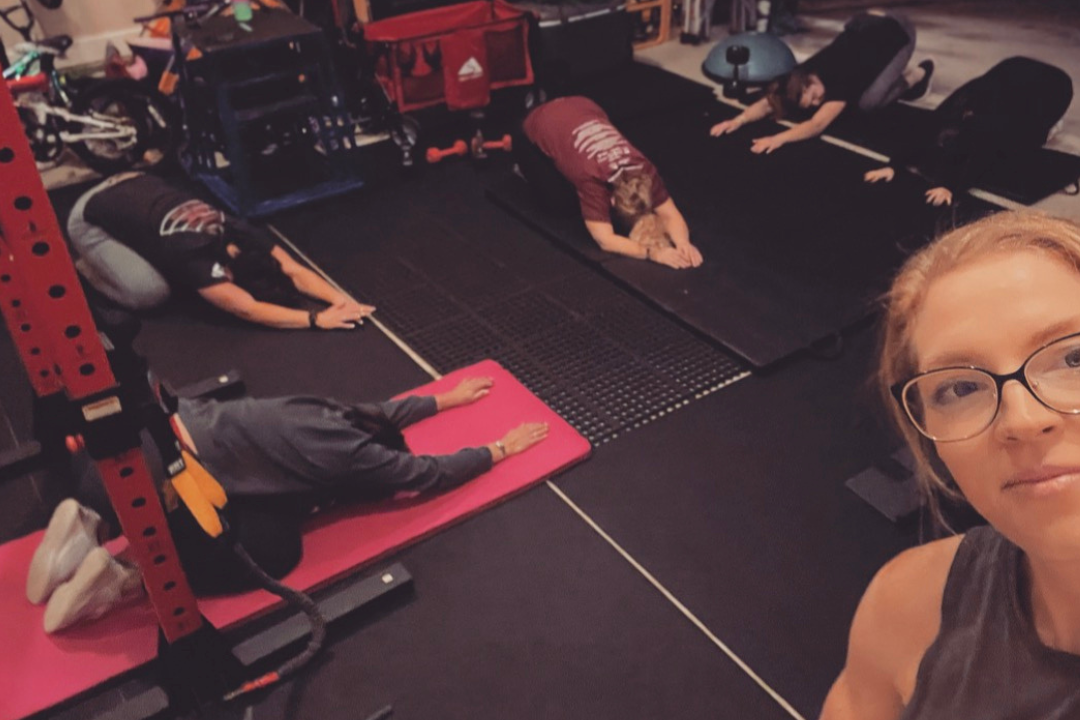
A quiet moment at the end of a group training session
